AI readiness · Operations transformation · Enterprise technology
The Situation
A large data center infrastructure team was drowning — not in work, but in prioritization. Every week, leadership reviewed a running list of 100 active projects and re-ranked them. Every week, staff showed up unsure of what actually mattered. And every week, requests kept coming in from every direction with no easy way to say no.
The team was busy. But they weren't finishing anything.
What I Did
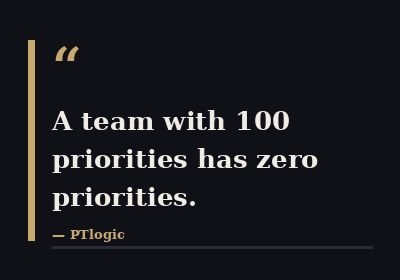
I audited how the team was spending its time and where priorities were breaking down. The problem wasn't effort — it was focus. So I redesigned the system around a single principle: a team with 100 priorities has zero priorities.
Working with leadership, I established a Top 5 framework — five active priorities at a time, aligned to what the customer actually cared about most. I replaced the exhausting weekly 100-item review with a lightweight check-in to adjust the list as needed.
Then I added one more tool: a printed card for every staff member.
Front: The current Top 5 priorities, updated weekly ·
Back: A single line — "Let me check with my management to see where this aligns with my priorities"
That line gave every staff member a professional, management-backed way to deflect low-priority requests without conflict or confusion. It sounds simple. It changed everything.
The Results
Team focus shifted entirely to customer-critical work · Projects were completed faster with fewer interruptions · Staff morale improved — people could finally see their work through to the end · Leadership gained confidence that the right work was getting done · Requests from outside the team were handled without conflict or escalation
The Takeaway
Clarity is a force multiplier. When a team knows exactly what the top 5 things are — and has the language to protect that focus — productivity and morale follow.
The instinct when a team is falling behind is to add process, add oversight, or add headcount. Most of the time, the answer is subtraction. Fewer priorities, clearer ownership, and a simple tool that makes it easy to say no to the wrong things.
The tool doesn't have to be complicated. It has to be used.
This engagement involved
-Delivery Friction Assessment
Identifying where the prioritization system was structurally broken
- Embedded Transformation
Designing and implementing the Top 5 framework through to full team adoption
Is your team busy but not finishing things?
30 minutes. No pitch deck. A direct conversation about what you're seeing and whether I can help.